Wednesday, February 16, 2011

India pt. 3: Jaipur

The "Pink City" of Jaipur, viewed from the Temple of the sun god "Surya"


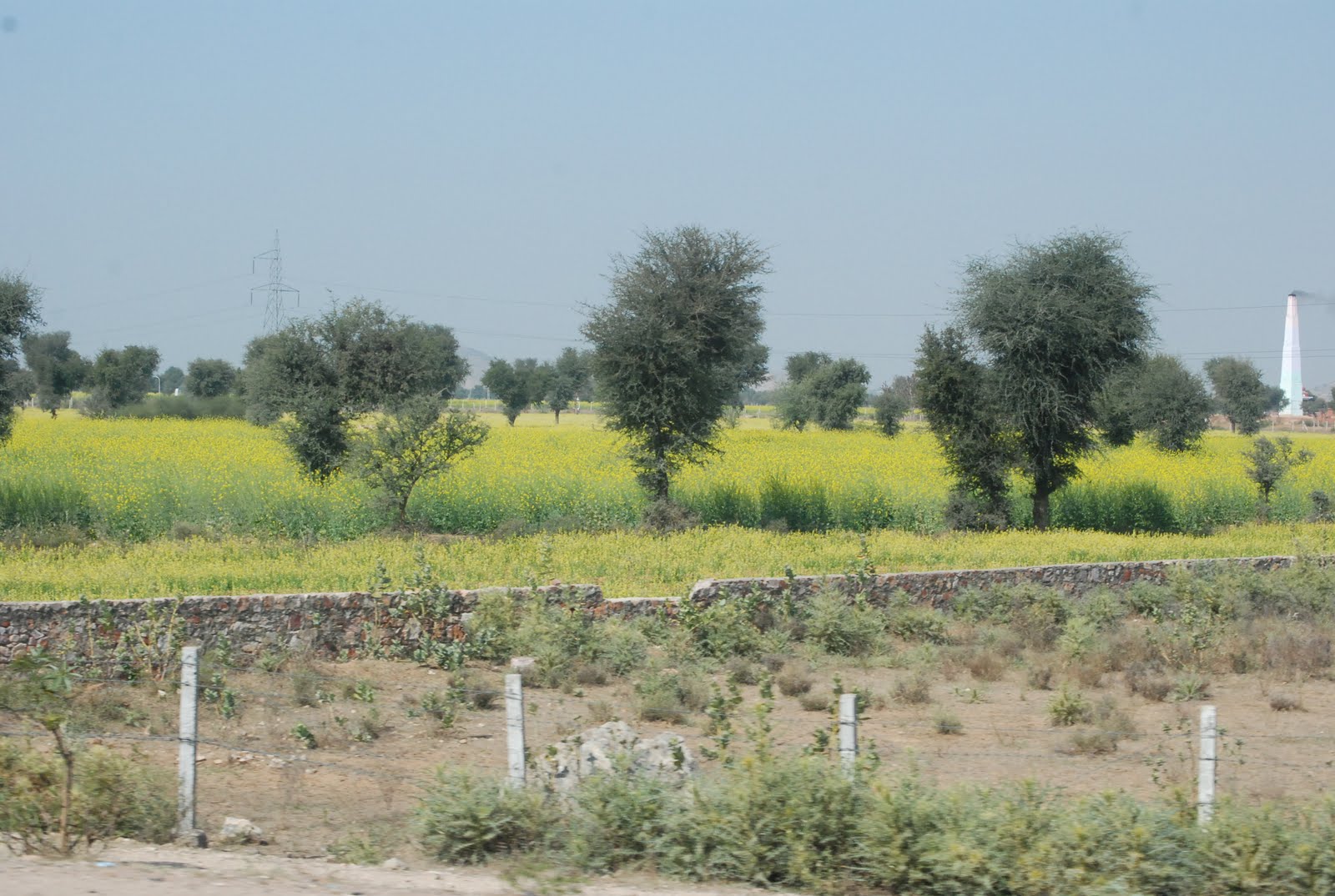
Most tourists who visit Rajasthan travel a circuit known as the "Golden Triangle." This itinerary includes Delhi, Agra, and Jaipur (usually returning to Delhi). The adjective is confusing, as the only really "golden" portion of our journey was the long drives through blooming fields of mustard (and those were, strictly speaking, more canary than golden). The cities themselves, however, are indisputably arranged in the shape of a triangle. On that point there can be little debate.


When we left Agra, we had already completed one "segment" of our triangle, and Jaipur was up next. We made our way slowly between the two cities, stopping once along the way to buy fruit ("2 rupees per banana?! Are you trying to rip me off?"), once to have a look at Fatehpur Sikri (described briefly in our previous post - refer to the section on the swan dive into the slime-filled pool), and again to enjoy a long (overpriced) lunch in a tourists' roadhouse of sorts. Around 4 in the afternoon, we found ourselves on the outskirts of Jaipur. Rus was riding shotgun with Sumer, and playing the role of navigator.

As we began to approach the city, Rus looked up from our trusty Lonely Planet Guidebook to inform us that there was a temple that we might like to visit on our way into town. The guidebook was cryptic and a little alarming in its description of the place: "Galta Monkey Temple is desolate...barren...evocative.... The macaques converge on the temple by the hundreds.... Prepare to be mobbed." Having recently learned that over 30,000 Indians die of rabies each year, we were a little nervous at the thought of hundreds of (potentially) rabid monkeys "converging" on us. Thus, when we arrived at the temple, we decided it best to hire a guide for about $2US, not so much for informative purposes (he could barely speak English), as to act as our bodyguard (or human shield if you prefer) against the anticipated waves of (possibly) rabid primates.


The temple itself was something out of Indiana Jones. Built into a ravine between two hills, the complex is made up of dozens of abandoned buildings... all of which were swarming with monkeys. Our guide brought with him a small bag of peanuts, which the monkeys immediately recognized. They followed us closely for most of our visit. The guide repeatedly tried to offer us peanuts ("feed monkey - good karma") but we politely declined.


"Feed monkey. Good karma!"

We slowly worked our way up the hill, walking past a number of "sacred" pools (read: stagnant ponds filled with green slime and bits of garbage), in which groups of pilgrims were bathing. We took a number of pictures of these, but upon closer inspection discovered that all but one photo depicted nude or semi-nude pilgrim-bathers. In the interests of propriety, we have included only one photo:At the top of the hill, we came to the Temple of "Surya" (the sun god). The view from the hilltop was magnificent, and we paused for awhile to watch the sun set over the city of Jaipur (and of course to snap a few pictures of the local guru and the "deity" in the temple):

The local guru (I had to pay him 25 cents to take this photo)


The sun god (left) and his wife (right)

Our guide posing in front of the "Surya" Temple (the sun god)

On our way down the hill, I decided to hand Emily the camera so that she could capture my bravery among the monkeys. Here's my best memory of the dialogue that ensued:

"Here Emily, take a picture of me."

"How do you turn the camera on again?"

"The switch on the top. Take the picture. The monkeys are getting closer to me"

"I think the flash is turned off. Do you want the flash on?"

"I'm not worried about the flash - I'm worried about getting rabies. Take the picture."

"Brad, there's a monkey looking at me. I'm nervous."

"There's two dozen of them looking at me. Take the picture."

*CLICK*

"Oh. There's a car in the background. Wait a minute, Brad. Let me take another one."


"Take the picture, Emily; the monkeys are re-grouping!"

We spent two nights in Jaipur, at a clean but simple bed-and-breakfast (more white toast and fried eggs, anyone?). At $15US per night, I was completely satisfied with our accommodation.

On our first morning in Jaipur, we explored the Amber fort:

Notice the elephant in the foreground

Followed by Jantar Mantar, an 18th Century observatory filled with wonderful, enormous sun dials:


We ended our visit with a stroll through the Old City marketplace:

An "autorickshaw," the tuk-tuk of India!

Cheap, delicious, and they throw in the hepatitis for free!

...and of course a little shopping:


Jaipur is referred to as the "Pink City," as the old city is nearly all painted a warm terracotta color. While this made for some excellent photographic opportunities, the crushing poverty and dirt of the city wore us down. By dinner time, we were ready to leave. Thankfully, we had only one more night in Jaipur.

As always, we invite your comments to our blog posts. Instead of questions, this week we have a writing challenge for you. See if you can post a comment with at least 3 of these words in it:

"monkeys" "palace" "rabid" "mustard"

Good luck!

Thursday, February 10, 2011

India pt. 2 - Agra, Akbar, and Underpants

In part 1 of our series on India, we introduced you to the "wonders" of Delhi: good food, bad pollution, and a hotel room that will haunt my dreams for years to come. In this post, we'll recount our adventures on the road and our 1 night stay in Agra. As you may or may not know, Agra is home to a million and a half Indians, a couple of really cool forts, and the Taj Mahal. It was the last of these that brought us to the city.
Just after our last breakfast in Delhi (boiled eggs and dry white toast anyone?), our driver showed up (right on time) to begin our driving tour of the "Golden Triangle." His name was "Sumer," and I am sorry to report that I took only one picture of him (above). He was an excellent driver, and made us feel quite safe for most of our trip (this is no small feat when driving in India). He did, however, have one idiosyncrasy that both amused and nauseated us: he liked to use our car as a laundromat. When he first picked us up, our friend Mel very kindly offered to sit by herself in the third row seat (in the back of the car). As we began to buckle ourselves in, we heard Mel start to chuckle. I turned around to see what she was laughing about and she brought my attention to a bit of Sumer's wet laundry which he'd laid out to dry on the seat next to Mel: his underwear. Being the good sport that she is, Mel never once complained about having to share her seat with our driver's unmentionables. Instead, she found herself a piece of newspaper, rolled it up, and proceeded to move the offending garment to a more suitable spot.


This became our daily routine. Every morning for the rest of the trip, Sumer would arrive punctually at our hotels to pick us up, and every morning we would find new evidence of his cleanliness. On one particular morning, I sat in the front passenger seat, just next to Sumer. About 15 minutes into our drive, I suddenly noticed that my jeans and jacket had been soaked through with moisture. At first, I thought that I had been sweating (this was India, after all). In my confusion, I wondered aloud, "Is my seat wet?" Although I hadn't intended to direct the question to him, Sumer replied, "yes sir." "Why?" I asked. "Washing, sir," was his matter-of-fact reply. "I see," was all I could manage to say in response.
Notwithstanding the soggy undies, we found our trips through the Indian countryside to be very enjoyable. Once we got out of the city, we found ourselves driving through endless fields of yellow. Sumer had explained to us earlier that he came from a farming background. I asked him about the yellow fields and his reply was simply "Mustard."

One of our favorite things about India was the brightly colored clothing we saw everywhere.

Agra was about a 5 hour drive from Delhi, which put our arrival at about the middle of the afternoon. On our way into town, we stopped at the tomb of "Akbar" - one of the most powerful Muslim rulers of 16th Century India (bear with me on matters of history - this stuff is actually interesting to me). I was excited to see the burial place of a king that I had recently taught my AP History students about, but I was soon distracted by the wildlife that roamed the grounds (we saw parrots, chipmunks, monkeys, and even a few wild deer):
Parrots at Akbar's tomb

Indian Chipmunk

After only about a half hour at Akbar's tomb, we drove on to the destination that had really brought us to Agra: The Taj Mahal. Having seen pictures of it all my life, I had been expecting the building to be a bit anti-climactic. It wasn't.
It was spectacular.

We had arrived about an hour and a half before sunset, and the warm afternoon light gave the building a rich glow. We hired a guide (for about $4 US), who showed us around the complex. He pointed out the beautiful semi-precious inlaid stones in the building's facade and directed us to the best locations for picture taking. He even took us to the bench that Prince Charles and Princess Di had sat on to take their pictures. Here's Emily's best impression of Lady Di:

And my best attempt to look "princely":
And, of course, the photo that Emily doesn't want me to post:
Agra had been described to us beforehand as a "wretched" place, worthy of no more than a night. On this advice, we stayed only one night (in the cleanest, friendliest bed-and-breakfast of our trip). On our second morning, we visited the Agra Fort...
The apartment in which Shah Jahan (builder of the Taj Mahal) was kept prisoner in his later years.


Emily the tour guide

Inlay work - Agra Fort

...as well as Fatehpur Sikri (Akbar's capital city, abandoned shortly after his death), where we watched a brave young man jump into an algae-covered pool, only to have him hassle us for money afterwards (Rus paid him $2, which seemed to satisfy him)...

Perhaps because we followed the advice we'd been given (staying only 1 night), we left Agra feeling good about the city. The people had been very friendly, and the historical sites were unforgettable.

In our next post, we'll be writing about Jaipur, the capital of Rajasthan.

If you'd like to comment (and we love to read them!), here's a few possible talking points:
1)How much money would it take you to jump into that green, slimy pool?
2)Who looks more regal in our "Royalty Picture": Emily or Brad?
3)Now that we've shared our favorite building in the whole world, what's yours?

Sunday, February 6, 2011

India pt. 1 - Delhi

It's Sunday afternoon here in Hong Kong and we've just returned from our week-long trip through Rajasthan, India. The floor of our living room is strewn with random trinkets and laundry, both of which seem to be creating a distinct "India smell" in our apartment. It's difficult to describe, although it seems to be a combination of incense, body odor, and air pollution.

This will be the first in a series of (probably) 4 posts on India. We visited 4 very different cities in our 7 days in India. Today's post will focus on our first stop: Delhi.

Delhi was our point of arrival in India: we flew in late Saturday night/early Sunday morning, and went straight to our hotel for a few hours' sleep. We had "splurged" on our accommodation in Delhi, reasoning that we would benefit from a couple nights of sound sleep. Turns out that $30 US per night, although expensive by Indian standards, doesn't go far in Delhi. Our hotel smelled constantly of burning garbage, the sheets were covered in mysterious stains, and our bathroom resembled a Guantanamo Bay interrogation cell. We were thankful that we'd brought our own sheets and towels.

Sunday morning we arranged for a whole-day taxi to take us to the sights around Delhi and (most importantly) to our cooking class. Our friends Rus and Mel came with us on this trip, and she had pre-arranged a cooking class for our first day. It was a great time.
We started off learning all about Indian spices and ingredients. We learned several "secrets" of Indian cooking. For example, did you know that Indian cooks "temper" their cooking oils by popping a few cumin or mustard seeds in the hot oil before adding further ingredients? Also, we learned the importance of fresh spices (used liberally, as you can imagine, in Indian cooking):
Our teacher in this cooking class was a lovely middle-class Indian lady who runs these classes out of her apartment as a means of supplementing her income. It was a real treat to be able to see an average middle-class Indian home on our first day.

The second secret of Indian cooking that we learned was the extensive utilization of oils and Ghee (clarified butter). Every curry we made began with about 1/4 cup of cooking oil or butter. Roughly 70% of Indians are vegetarian (mostly for religious reasons). To a westerner, this statistic sounds depressing. However, I've discovered that vegetarian cuisine can be just as rich and fattening as meat-based dishes. All you've got to do is add a couple sticks of butter to each of your recipes. You'd be surprised at the number of overweight vegetarians you see in India.

For the "frying" portion of our class, we stepped out onto the balcony:
Our cooking class concluded with an amazing meal, and at about 4pm, we finally pushed back our chairs, wiped our mouths, and headed out to explore the historic sites in the city.

We started with a trip to Humayun's tomb. This is the burial place of one of the early Mughal (Muslim) rulers of northern India. He was the great-grandfather of Shah Jahan (builder of the Taj Mahal). His tomb is referred to as the first monument in India to borrow architectural styles from the Persians (present-day Iran). Although we spent 3 years living in the Middle East, this was the first time that we had seen buildings that reminded us of Aladdin. I spent the rest of the trip trying to find myself a midriff-baring silk vest and puffy pants. No success.
At the end of the day, we worked our way back to the "India Gate" (below), an enormous arch near the city center which is dedicated to India's war dead.

After two nights and really only one day, we stuffed our things into our backpacks and set out for Agra. Overall, we found Delhi to be a bit of a shock. We had expected things to be busy, crowded, polluted, and generally chaotic... just like Cairo (we thought). What we found was a bit more extreme than we'd expected. The poverty was more grinding, the piles of garbage a little higher, and the beggars just a little more desperate than we had remembered from Egypt. It's possible that our months in affluent, organized Hong Kong have softened us, but we both agreed that Delhi was generally more extreme than Cairo. It was a fascinating city, but neither of us was in any hurry to relocate there.

In part 2 of our India series, we'll discuss the adventures of life on the road in India (including some fun stories involving our private driver: "Sumer"). We'll also discuss our experiences in Agra.

We encourage you to post your comments to let us know that people are still reading our blog (especially after that long spell of silence around Christmas time). Here are a few talking points if you'd like to comment:'
1) Who would look better in the Aladdin vest and puffy pants: Brad or Emily?
2) Do you think we were crazy to bring our own sheets and towels to India?
3) What was your most intense or memorable Third World city experience?
4) Do you enjoy Indian food as much as we do? If so, what's your favorite dish? (For Brad, it's a tie between Butter Paneer Masala and Vegetable Kofta. Emily loves kashmiri potato eggplant Curry)